




-
JCI Gutter Services
-
 Home Maintenance
-
 0 Comments
-
 June 8, 2026
5 Gutter Repair Mistakes That Could Cost You Thousands
Understanding the True Cost of Repair Errors
When homeowners search for solutions to gutter problems, they often underestimate how a single misstep during repairs can spiral into costly structural damage. In Le Roy and throughout Monroe County, seasonal freeze-thaw cycles combined with heavy spring rainfall create unique challenges that demand precise repair techniques. What begins as a minor fix can quickly become a multi-thousand-dollar nightmare when approached incorrectly.
Your gutter system serves as the first line of defense against water infiltration, directing thousands of gallons away from your foundation each year. During New York’s wet springs and snow-heavy winters, gutters work overtime to protect your investment. Unfortunately, many well-intentioned repair attempts overlook critical details that professional contractors recognize immediately, setting the stage for foundation cracks, basement flooding, and exterior damage that far exceeds the original repair cost.
This guide reveals the seven most damaging mistakes homeowners and inexperienced contractors make during gutter repairs. By understanding these pitfalls before they occur, you can protect your home from the expensive consequences that follow improper installation, material mismatches, and structural oversights. Whether you plan to tackle repairs yourself or hire a professional, knowing what to avoid is the first step toward long-term protection.
Using Mismatched Materials and Fasteners
One of the most expensive errors occurs when homeowners or contractors mix incompatible materials during repairs. Combining aluminum gutters with steel screws, for example, triggers galvanic corrosion that eats through metal in just a few seasons. This chemical reaction accelerates in regions like ours, where road salt residue becomes airborne during winter months and settles on roofing systems.
The problem intensifies when repair patches use different gauge metals than the existing system. A thinner replacement section creates a weak point that sags under snow load or pulls away during ice dam formation. What appears to be a successful repair in July fails catastrophically by February, often taking surrounding sections with it and requiring complete replacement of entire runs.
Professional installations match every component to the existing system specifications, from hangers to end caps. They account for thermal expansion rates, ensuring screws and brackets accommodate seasonal metal contraction without cracking seals. Skipping this attention to material compatibility might save a few dollars initially, but the resulting leaks, rust stains, and premature failure quickly multiply costs. When sections fail during heavy weather, the resulting water damage to siding, windows, and foundation work can easily reach five figures.
Ignoring Proper Slope and Pitch Requirements
Gravity does the heavy lifting in any drainage system, but only when gutters maintain the correct pitch toward downspouts. The standard quarter-inch drop per ten feet of run seems minor, yet this precise angle makes the difference between effective drainage and standing water. Many repair attempts ignore this specification entirely, simply reattaching sections at whatever angle seems level to the eye.
Standing water breeds mosquitoes in summer and turns to destructive ice in winter. In Le Roy, where temperatures fluctuate above and below freezing throughout late fall and early spring, trapped water expands repeatedly, stressing seams and joints until they split. The resulting leaks direct water straight down exterior walls, saturating insulation and rotting structural framing behind siding where damage remains invisible until it becomes severe.
Incorrect pitch also prevents debris from washing toward downspouts during rainfall. Leaves and granules accumulate in low spots, creating dams that overflow during the next storm. Homeowners who fix sagging sections without checking slope often find their repairs fail within months, requiring complete reinstallation with proper measurements. Professional contractors use laser levels and precise calculations to ensure every foot of gutter maintains optimal flow, eliminating the recurring problems that plague amateur repairs.
Overlooking Fascia Damage Before Repairs
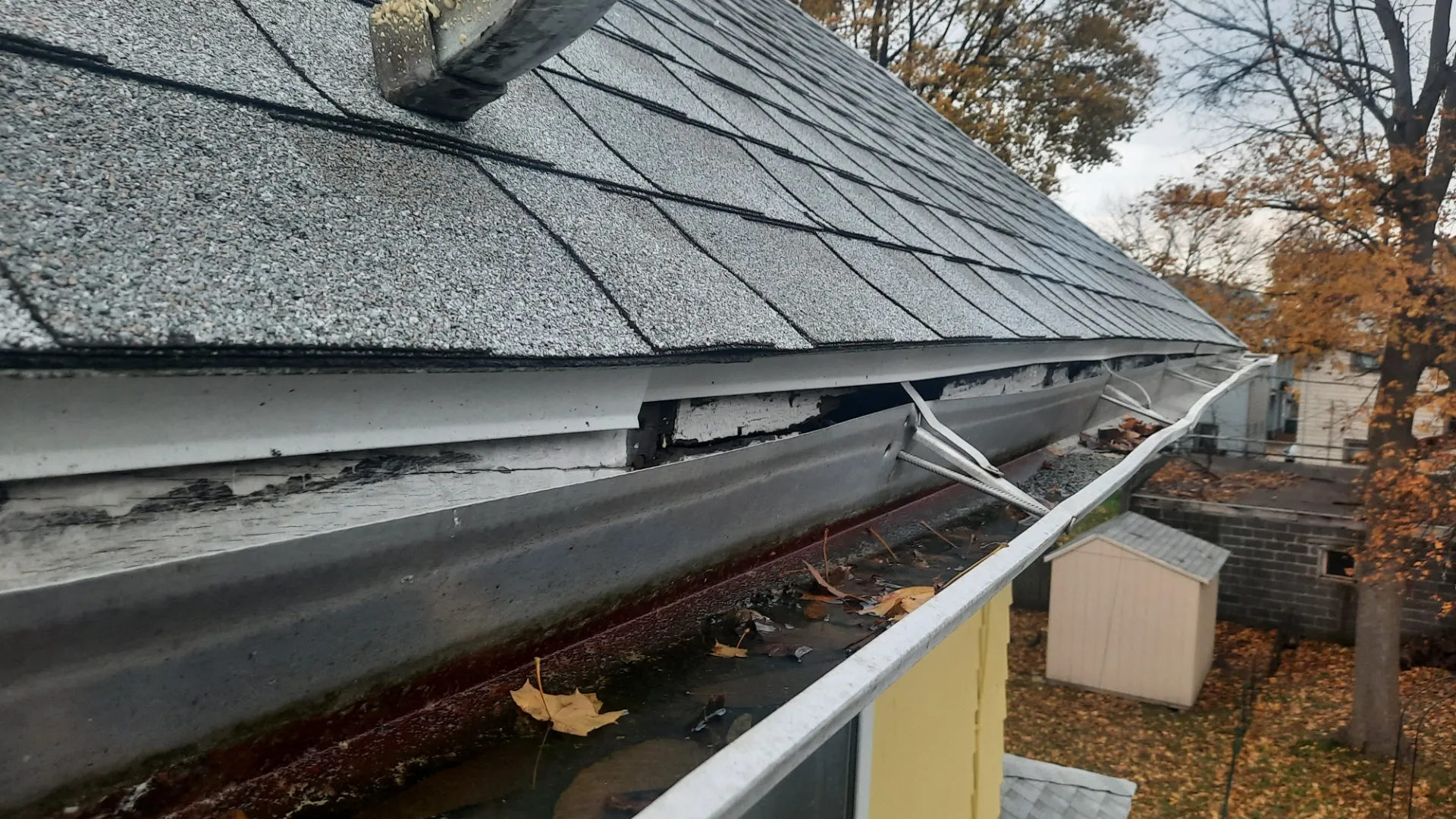
Gutters attach to fascia boards, the wooden trim running along your roofline. When existing gutters fail, they often do so because water has already compromised the fascia behind them. Reattaching gutters to rotted or weakened fascia guarantees failure, yet this mistake happens constantly because the damage hides behind the gutter itself until someone removes it for inspection.
Soft, spongy fascia cannot hold fasteners securely. Screws pull out under the weight of water-filled gutters, especially during the heavy spring rains that drench our region. The gutter separates from the house, dumping hundreds of gallons directly against the foundation. By the time homeowners notice the detachment, basement seepage or foundation cracks may already be developing, problems that cost exponentially more than the original repair.
Professional contractors always inspect fascia condition before securing new gutters or reattaching existing runs. They probe for soft spots, check for rot, and replace compromised sections with treated lumber that can support the system long-term. This adds to project costs upfront but prevents the cycle of repeated failures that occurs when gutters mount to inadequate backing. Skipping fascia inspection to save money virtually guarantees you will pay for the same repair multiple times, plus the additional damage each failure causes.
Inadequate Sealing at Joints and Seams
Every connection point in a sectional system represents a potential leak. Corners, downspout outlets, and section joints require proper sealant application to remain watertight under pressure. Many repair attempts use generic silicone caulk instead of specialized gutter sealant, a substitution that fails within a single season as temperature swings cause the improper sealant to crack and separate.
Even when using correct materials, application technique matters enormously. Applying sealant to wet or dirty surfaces prevents proper adhesion. Insufficient curing time before the next rainfall washes uncured sealant away. Overapplication creates ridges that trap debris and prevent proper water flow. Each of these errors creates leak points that direct water behind siding or down foundation walls, causing damage that exceeds the repair cost many times over.
Seamless systems eliminate most joints entirely, which is why professionals often recommend them for replacement projects. When sectional repairs are necessary, experienced contractors clean and dry all surfaces thoroughly, apply appropriate sealant in correct amounts, and allow proper curing before testing the system. They also inspect surrounding joints during repairs, since failure in one area often indicates stress or aging affecting adjacent connections. Addressing only the obvious leak while ignoring the conditions that caused it sets homeowners up for repeated emergency calls and escalating damage. When you work with qualified professionals like those at licensed installation contractors, you ensure every seal meets manufacturer specifications for long-term performance.
